ไทยth Englishen françaisfr Deutschde русскийru españoles portuguêspt 한국의ko Türkçetr Polskipl
บล็อก
บ้าน /

บล็อก

Coin Cell Parts

July 08 , 2025

Xiamen Tmax Battery Equipments Limited was set up as a manufacturer in 1995, dealing with lithium battery equipments, technology, etc.  We have total manufacturing facilities of around 200000 square foot and more than 230 staff. Owning a group of experie-nced engineers and staffs, we can bring you not only reliable products and technology, but also excellent services and real value you will expect and enjoy.


Coin cells, also known as button cells due to their shape resembling a button, are small, thin batteries often used in compact electronic devices such as watches, calculators, medical devices, and other lowpower electronics. They come in various chemistries including lithium, silver oxide, and alkaline. Below is an overview of the main parts that constitute a coin cell battery:

Main Parts of a Coin Cell

1. Cathode Material (Positive Electrode)
    This is the positive part of the battery. The material used depends on the chemistry of the cell:
      Lithium Coin Cells: Commonly use manganese dioxide (MnO2) or carbon monofluoride ((CF)x).
      Silver Oxide Coin Cells: Use silver oxide (Ag2O) as the cathode material.
      Alkaline Coin Cells: Utilize manganese dioxide (MnO2).

2. Anode Material (Negative Electrode)
    This is the negative part of the battery. Again, the material varies based on the chemistry:
      Lithium Coin Cells: Lithium metal is typically used.
      Silver Oxide Coin Cells: Zinc is commonly employed.
      Alkaline Coin Cells: Also use zinc.

3. Electrolyte
    Serves as a medium for ions to move between the anode and cathode. Different chemistries use different electrolytes:
      Lithium Coin Cells: Often use organic electrolytes like lithium perchlorate in an organic solvent.
      Silver Oxide Coin Cells: Typically contain an alkaline electrolyte like potassium hydroxide (KOH).

      Alkaline Coin Cells: Use an alkaline electrolyte, usually potassium hydroxide (KOH).


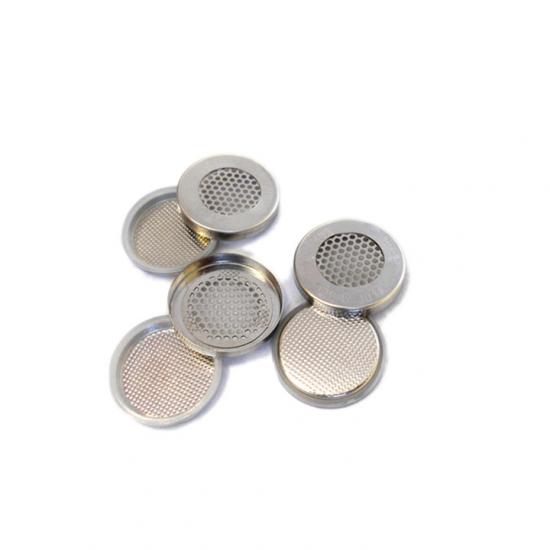
Cr2032 Coin Cell Case


4. Separator
    A porous material placed between the anode and cathode to prevent direct contact while allowing ion flow. It's crucial for preventing short circuits.

5. Can (Outer Shell)
    The outer casing that houses all the internal components. It's usually made of stainless steel and acts as the positive terminal.

6. Insulator/Sealing Gasket
    Made from materials like nylon or PTFE (Teflon), it seals the battery and prevents leakage of the electrolyte. It also electrically insulates the top cover from the can.

7. Top Cover (Negative Terminal)
    Usually made of nickelplated steel, it serves as the negative terminal and is sealed with the insulating gasket to ensure no leaks occur.

These components work together to provide power in a compact form factor suitable for miniature devices. The choice of materials for each part is critical in determining the performance characteristics of the coin cell, such as its voltage, capacity, operating temperature range, and shelf life.

บล็อกใหม่

แท็ก

บ้าน

สินค้า

เกี่ยวกับ

ติดต่อ
